Langtang Gosaikunda Trek

DestinationNepal
Duration13 Days
DifficultyModerate
ActivitiesTrekking & Exploration
AccommodationTeahouses & Lodges
Meals PlanBreakfast, Lunch, Dinner
Max. Elevation4,610 m
Group SizeMin. 1 Pax
Best SeasonSpring & Autumn
Start / FinishSyabrubesi / Sundarijal

Langtang Gosaikunda Trek Overview

The Langtang Gosaikunda Trek is a worthwhile trek through the unique geography of Langtang, Nepal, and the sacred alpine lakes of Gosaikunda. This journey takes you through traditional Tamang villages, dense forests, glacial valleys, high mountain viewpoints, and alpine terrain, just north of Kathmandu. This is a great option for trekkers looking to experience the Himalayas, local culture, and religious traditions in one journey.

The Langtang Gosaikunda Trek begins with a drive from Kathmandu to Syabrubesi, the starting point of the trekking journey. This leads to the Langtang River, following the bamboo, oak, and rhododendron forests and passing through small villages and waterfalls. The landscape becomes more open towards the higher altitude mountain valleys, which offer views of mountain peaks and glaciers. After passing Lama Hotel and Langtang Village, you will get to the traditional mountain village of Kyanjin Gompa (3,870 m). Here, you can visit the yak cheese factory, see the monastery, and get a great view of the mountains. There is also a optional hike option to Kyanjin Ri or Tserko Ri to get a better view of the nearby mountains and glaciers.

The trail descends through the Langtang Valley before heading towards Thulo Syabru. The trail takes you along traditional Tamang villages, forested hills, and peaceful mountain paths before taking you above the tree line. Along the way, you’ll get an experience of the local way of life, Buddhist traditions, monasteries, and the warm welcome of the mountain people.

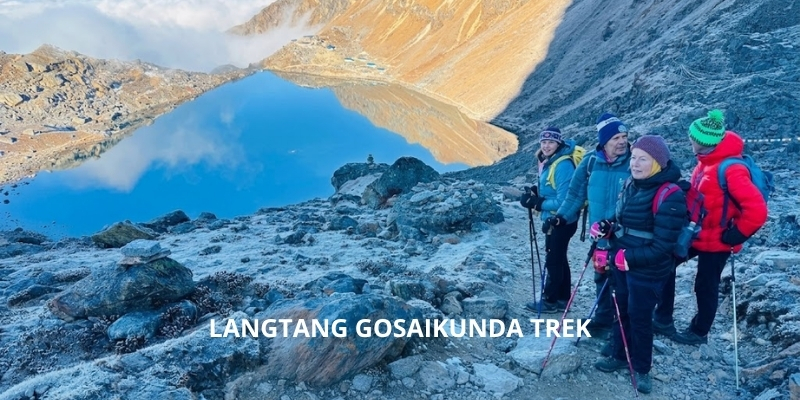
Another major attraction is Gosaikunda Lake (4380 m), a stunning alpine lakes located on rocky mountain slopes and Himalayan peaks. The lake has great religious significance for both the Hindus and the Buddhists. According to Hindu mythology, Lord Shiva created Gosaikunda by striking the mountain with his trident to find water after he swallowed poison during Samudra Manthan. In addition to its religious significance, the Gosaikunda lake complex is also considered a Ramsar wetland of International importance due to its ecological value.

After Gosaikunda, you’ll cross Lauribina La Pass (4,610 m), one of the highest points on the route. The pass provides an amazing view of the surrounding ranges of the Himalayas before the trek takes you down towards Ghopte, the Helambu region and ends with drive to Kathmandu from Sundarijal.

The Langtang Gosaikunda Trek is a moderate to difficult high-altitude trek due to the long days of walking, high uphill sections, varying terrain, and ascent. It is not a technical trek, but physical fitness and acclimatization are important, especially for Lauribina La. The ideal times to do this trek are Spring (March – May) or Autumn (September – November), when the weather is more pleasant and mountain views are clearer.

Langtang Gosaikunda Trek Highlights

  • Explore the diverse landscapes of Langtang National Park from dense bamboo, oak, pine, and rhododendron forests to peaceful river valleys, alpine meadows, and Himalayan landscapes.
  • Visit traditional villages like Langtang Village and Thulo Syabru, interact with local communities, and experience their unique traditions.
  • Explore Langtang Village, which was heavily affected by the 2015 earthquake and subsequent avalanche.
  • Visit the beautiful mountain village of Kyanjin Gompa, explore its Buddhist monastery, and learn about traditional yak cheese production.
  • Take an optional uphill hike to popular viewpoints, Tserko Ri or Kyanjin Ri, for stunning views of Langtang Lirung, glaciers, and other surrounding peaks.
  • Witness the amazing mountain scenery of Langtang Lirung, Dorje Lakpa, Ganesh Himal, and other peaks throughout the journey.
  • Explore Gosaikunda Lake, one of Nepal’s alpine pilgrimage destinations, surrounded by rocky mountain slopes and beautiful high-altitude scenery.
  • Cross the high-altitude Lauribina La Pass (4,610 m) and enjoy views of the surrounding Himalayan landscapes.

Itinerary of Langtang Gosaikunda Trek – 13 Days

DISTANCEDrive 5–7 km
DURATION20–40 minutes
HIGHEST ALTITUDE1,400 m
OVERNIGHTKathmandu
MEALSBLD
ACCOMMODATIONHotel in Kathmandu

On arrival at Tribhuvan International Airport, you will meet our representatives and drive to your hotel. Once checked in, you have the option to rest or head to the nearby streets of Thamel, a popular tourist hotspot with shops, restaurants, and trekking equipment stores.

In the afternoon, your trek guide will brief you about your Langtang Gosaikunda Trek. They will explain the route, finalize your trekking gear, and make any remaining preparations for your trek to the Langtang region. Stay overnight at a three-star hotel in Kathmandu.

DISTANCE120–145 km
DURATION7–9 hours
HIGHEST ALTITUDE1,550 m
OVERNIGHTSyabrubesi
MEALSBLD
ACCOMMODATIONTeahouse in Syabrubesi

After breakfast, you will begin your journey towards Syabrubesi, the gateway to Langtang Valley and Gosaikunda. The drive starts from Kathmandu city as it winds through the Trishuli River, rural settlements, terraced hillsides, and forest areas. You will pass through the bazaar of Trishuli and Dhunche before you reach Syabrubesi.

The landscape around Syabrubesi is lush and green, with river valleys and surrounding hills providing your first glimpse of the adventure ahead. Once you’re in the village, you can relax in your teahouse and get ready for the next day’s trek.

DISTANCE10–12 km
DURATION5–6 hours
HIGHEST ALTITUDE2,470 m
OVERNIGHTLama Hotel
MEALSBLD
ACCOMMODATIONTeahouse at Lama Hotel

Your first day of trekking begins after breakfast in Syabrubesi. Cross the suspension bridge over the Bhote Koshi River and walk next to the Langtang Khola along a scenic wooded valley.

The trail gradually descends through small settlements and lush forests, which include Pairo and Bamboo. The area is known for thick forests of oak, rhododendron and bamboo that create a peaceful ambiance for walking. You’ll also see wildlife like langur monkeys and various bird species along the way.

Following a short pause at Bamboo, you will head on towards Rimche, where there are a couple of steeper uphill sections on the trail. This leads into another section of forest that takes you to Lama Hotel, a small village located in dense forest.

DISTANCE12–14 km
DURATION5–7 hours
HIGHEST ALTITUDE3,430 m
OVERNIGHTLangtang Village
MEALSBLD
ACCOMMODATIONTeahouse in Langtang Village

Following breakfast, proceed further up the Langtang Valley through forested and open mountain terrain along the Langtang Khola.

The first stretch of the trail goes through Ghoda Tabela, a beautiful stopping point amidst alpine forests and mountain scenery. The woods become more open, and you can see the other peaks as you climb higher.

As you head towards the higher Langtang settlements, you will also see a shifting topography. The trail runs through smaller seasonal villages, and then leads up to the culturally important Tamang village of Langtang Village that was devastated by the 2015 earthquake and subsequently rebuilt.

The traditional lifestyle of the village is reflected in its stone houses, mountain lodges, prayer flags, and beautiful view of Langtang Lirung. Overnight and dinner at Langtang Village.

DISTANCE6–7 km
DURATION3–4 hours
HIGHEST ALTITUDE3,870 m
OVERNIGHTKyanjin Gompa
MEALSBLD
ACCOMMODATIONTeahouse at Kyanjin Gompa

Today you’ll head up into the upper Langtang Valley towards Kyanjin Gompa, one of the most beautiful villages in the area. The section is fairly short and takes you through open alpine terrain, compared to the previous days.

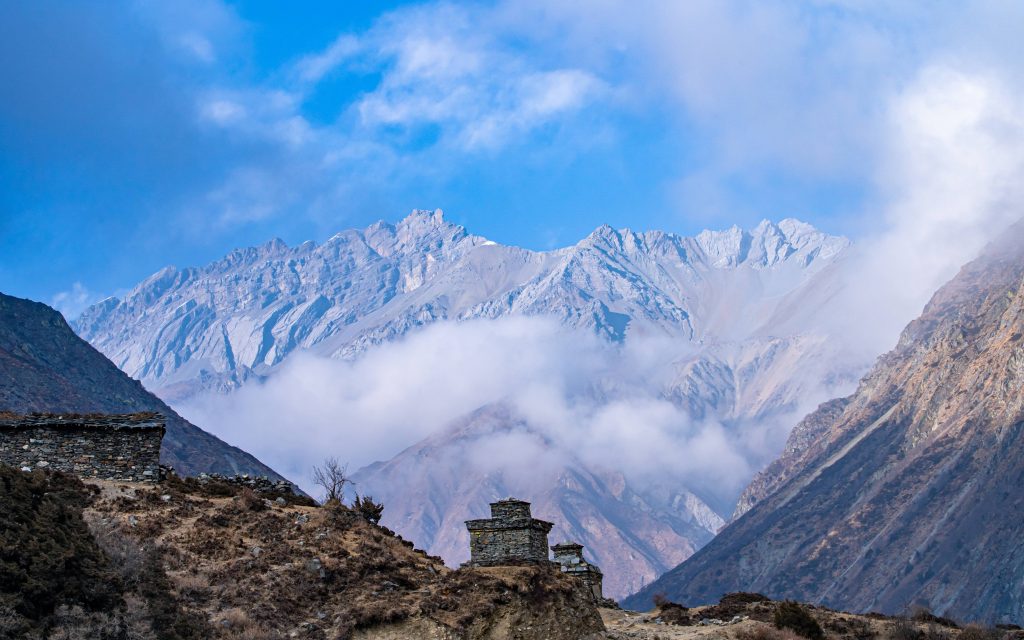
You will also see Tibetan influences in the local culture, like traditional stone settlements, mani walls, prayer wheels, and Buddhist chortens along the way. This area slowly becomes more open and has great views of Langtang Lirung and the other peaks.

In about 3-4 hours, you’ll get to Kyanjin Gompa, a peaceful mountain village surrounded by the amazing landscapes of the Himalayas. You can go around the village, visit the old monastery, or the local yak cheese factory to learn how to make yak cheese. Stay overnight and have dinner at Kyanjin Gompa.

DISTANCE5–10 km
DURATION4–9 hours (optional hiking).
HIGHEST ALTITUDE3,870 m.
OVERNIGHTKyanjin Gompa
MEALSBLD
ACCOMMODATIONTeahouse at Kyanjin Gompa

This day is set aside for acclimatization and exploring the beautiful surroundings of Kyanjin Gompa. An acclimatization day at Kyanjin Gompa allows your body additional time to adjust to the altitude. However, proper acclimatization should continue throughout the trek, especially before reaching Gosaikunda and crossing Lauribina La.

There are various hiking options available for the day, and you can choose based on fitness, weather conditions, and energy levels. One of the most popular viewpoints near Kyanjin Gompa is the Kyanjin Ri (4,773 m). This is a steep climb up a hill, but the view at the top is worth it, as you will see Langtang Lirung, Langtang Ri, and other peaks in the surrounding Himalayas.

If you want to get even higher, then Tserko Ri (4,984 m) can be the best option for your day hike. This hike is longer and steeper but worthwhile as it offers views of glaciers, mountain ridges, and the upper Langtang Valley. The round trip will take about 7-9 hours depending on pace and conditions.

For a gentler day, it’s possible to explore the village itself, visit the yak cheese factory or go for shorter hikes around the nearby valley. Then return to your teahouse at Kyanjin Gompa for an overnight stay.

DISTANCE19–21 km
DURATION6–7 hours
HIGHEST ALTITUDE2,470 m
OVERNIGHTLama Hotel
MEALSBLD
ACCOMMODATIONTeahouse at Lama Hotel

After an acclimatization day at Kyanjin Gompa, you will start your descent back down to Lama Hotel along a large part of the route of Langtang Valley.

The trail goes through the well-known villages of Langtang Village and Ghoda Tabela. But the downhill offers another view of the valley, as the landscape of mountain slopes, forests, and the Langtang Khola changes.

The open alpine area slowly changes back to thick forest as elevation decreases. There are familiar areas in the forest that you will pass through before arriving at Lama Hotel.

The walk is mostly downhill, but the length of the walk and uneven ground can take a toll on the knees. Descending can be easier if walks are done at a comfortable pace and with the use of trekking poles.

DISTANCE10–12 km
DURATION5–6 hours
HIGHEST ALTITUDE2,260 m
OVERNIGHTThulo Syabru
MEALSBLD
ACCOMMODATIONTeahouse in Thulo Syabru

Following breakfast, you will head towards Thulo Syabru. The trek starts in a forested area, going down to the lower Langtang Valley. The road then goes through familiar wooded areas before getting to the junction area where the trail turns towards Thulo Syabru.

The trail continues with an uphill ascent into the village here. As you enter Thulo Syabru, the landscape showcases terraced farming areas, rustic dwellings, and scenic views of the surrounding hills.

Thulo Syabru is an interesting cultural destination on the trek. After that, one can enjoy the village and the traditional architecture of the Tamang people, and enjoy the lifestyle before heading towards Gosaikunda. Stay overnight and have dinner at Thulo Syabru.

DISTANCE7–9 km
DURATION4–5 hours
HIGHEST ALTITUDE3,330 m
OVERNIGHTSing Gompa
MEALSBLD
ACCOMMODATIONTeahouse at Sing Gompa

Today, you will leave Thulo Syabru and start a gradual uphill journey towards Sing Gompa (also known as Chandanbari). This is one of the more challenging walking days before reaching Gosaikunda.

The path winds through a thick forest of oak, pine, and rhododendron trees, and through small open areas and traditional mountain villages. The higher you go, the colder it will get and the more open the views of the surrounding Himalayan scenery will be.

Continue walking for about 4-5 hours, and you will get to Sing Gompa, a peaceful village that has a Buddhist temple as well as a local yak Cheese factory.

You can explore the monastery and even visit the cheese factory in the village. Sing Gompa is also a good rest stop, which will pave the way for the subsequent day’s ascent towards Gosaikunda.

DISTANCE8–10 km.
DURATION5–6 hours
HIGHEST ALTITUDE4,380 m
OVERNIGHTGosaikunda
MEALSBLD
ACCOMMODATIONTeahouse near Gosaikunda Lake.

Following breakfast, you’ll head towards the holy Gosaikunda Lake, which is one of the highlights of the entire trek.

The path follows a forested section till it reaches Cholangpati and then follows the bare mountain ridges to Lauribina. As you ascend, the woods become sparser, and then you enter rocky alpine territory accompanied by views of the Himalayas.

From Lauribina, the view of Langtang and Ganesh Himal ranges, and other surrounding peaks is very impressive. The path then heads towards Gosaikunda, where the scenery gets even more adventurous due to narrow sections.

As soon as you get to Gosaikunda Lake, rocky mountains and some glacial lakes surround you. The primary lake is of great religious importance to the Hindu and Buddhist community, and the lake’s name is traditionally linked to Lord Shiva.

Explore by the lake and take in the tranquility before heading to a nearby Teahouse. But don’t engage in unnecessary strenuous activity so that the body can acclimatize to the altitude.

DISTANCE10–14 km
DURATION6–8 hours
HIGHEST ALTITUDE3,440 m
OVERNIGHTGhopte
MEALSBLD
ACCOMMODATIONTeahouse at Ghopte

This is one of the most challenging and memorable days of the Langtang Gosaikunda trek, as it crosses Lauribina Pass (Lauribina La) at about 4610 m.

Your journey begins early in the morning, and you will climb above the Gosaikunda Lakes up to the pass. Once you reach Lauribina Pass, you can take in the stunning scenery of the surrounding Himalayan ranges and appreciate the mountain landscape. The high-altitude crossing is one of the highlights of the hike, a great opportunity for adventure seekers.

Then, from the pass, you will start a descent towards Phedi and then through rocky areas and forested sections to Ghopte. The descent can be steep and physically demanding.

Ghopte is a small village in the mountains, where you can spend the night at simple teahouses after you have had a very long day.

DISTANCE13–15 km
DURATION6–8 hours
HIGHEST ALTITUDE2,470 m
OVERNIGHTKutumsang
MEALSBLD
ACCOMMODATIONTeahouse in Kutumsang

As usual, the day begins after breakfast. You will trek towards Kutumsang in the beautiful Helambu region. The path starts with a steep climb through the woods, then heads to Thadepati, a significant ridge village and viewpoint on the way.

Thadepati has a stunning view of the surrounding ranges of the Himalayas and rolling green hills. After the viewpoint, you will go down through the rhododendron forests and small settlements to Kutumsang. The route goes through tranquil rural land, providing you one more chance to enjoy the natural and cultural richness of the Helambu region.

Kutumsang is a traditional high mountain village with teashops to rest after the day’s hike.

DISTANCE14–16 km
DURATION6–7 hours
HIGHEST ALTITUDE2,215 m
OVERNIGHTChisapani
MEALSBLD
ACCOMMODATIONTeahouse in Chisapani

In today’s journey, you will head towards Chisapani in the hills and rural settlements.

As you trek, you will see the local way of life in the small villages and communities on the hillside, including local farming and the traditional houses that you will come across on the way.

This part goes through green hills, through forests, through terraced fields, and through small settlements. As you get near to Chisapani, the landscape provides a view of surrounding hills and the far peaks of the Himalayas.

Once you get to Chisapani, you can get a restful night’s sleep in your teahouse and spend the last night in the mountains.

DISTANCE9–11 km
DURATION4–5 hours
HIGHEST ALTITUDE1,400 m
OVERNIGHTKathmandu
MEALSBLD
ACCOMMODATIONHotel in Kathmandu

Finally, your adventure will end with a descent to Sundarijal from Chisapani, which is through the picturesque forest of Shivapuri Nagarjun National Park.

The path takes you along oak and rhododendron forests, small towns, and stone steps. You’ll get to see streams, waterfalls, and green hillsides along the way, which will provide a refreshing break from the high elevation scenery of the days before.

As you reach Sundarijal, the route becomes more established and leads to a popular locality with waterfalls and water reservoirs.

Once in Sundarijal, you will meet your vehicle and then drive back to Kathmandu. This takes about 45 minutes to 1.5 hours, depending on the traffic.

After arriving in Kathmandu, you’ll be driven to your accommodation, where you will spend the night.

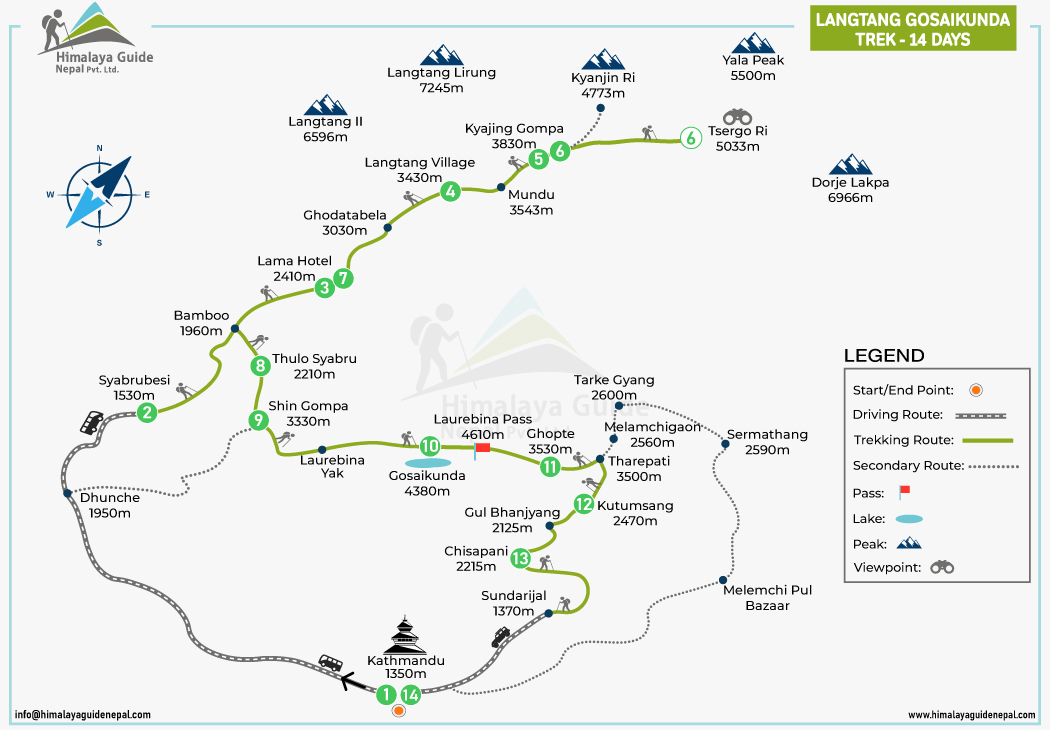
Route Map of Langtang Gosaikunda Trek

langtang-gosaikunda-trek-map

Inclusions & Exclusions of Langtang Gosaikunda Trek

What is Included

Covered in your trip price

  • International airport pick-up and drop-off service.
  • 2 nights’ accommodation in a standard hotel in Kathmandu. [BB Plan on twin-sharing basis]
  • Local bus transportation from Kathmandu to Syabrubesi.
  • Transportation from Sundarijal to Kathmandu by public bus (private vehicle available as an option).
  • Drop-off at the Hotel in Kathmandu.
  • Three meals daily (Breakfast, Lunch, and Dinner along the trek).
  • Lodge accommodation on the way.
  • An experienced trekking guide (including his salary, equipment, insurance, lodging, and food)
  • Equipment: Down Jacket, Sleeping Bag.
  • A legal document (National Park Trekking Permit)
  • A token of love from the company.
  • All Government VAT.
  • Some dry and seasonal fruits.
  • A farewell dinner or lunch is a suitable time.

What is Not Included

Plan for these separately

  • Extra accommodation in Kathmandu.
  • Travel insurance.
  • Hot and cold drinks such as Coca-Cola, mineral water, beer, and other beverages.
  • Porter service (including his salary, equipment, insurance, transportation, lodging, and food)
  • Personal expenses such as laundry, bar bills, telephone calls, extra charging fees, hot showers, and boiled drinking water.
  • Tips for guides and porters (not included in the package cost).

What Our Trekkers Say

Read authentic feedback, trail stories, and heartfelt memories shared by travelers who have explored the Himalayas with our certified local mountain leaders.

5.0 / 5.0• Based on 2 trekker stories

Select Your Departure Date

Pick a start date that suits you. We run this trek on any day of the year, for solo travelers and private groups alike.

November 2026
SUMOTUWETHFRSA
December 2026
SUMOTUWETHFRSA
YOUR TRIP
Fri, 27 Nov 2026 → Thu, 3 Dec 2026· 13 days

Additional Information of Langtang Gosaikunda Trek

Langtang Gosaikunda Trek Difficulty

The Langtang Gosaikunda Trek is graded as moderate to difficult. While prior technical mountaineering skills are not required, daily walking spans between 5 to 7 hours across steep stone staircases, forested ridgelines, and high alpine scree.

Crossing Lauribina La Pass (4,610 m) after exploring the sacred Gosaikunda Lakes is the physically most demanding milestone. Pacing yourself with steady, measured breaths, ascending gradually, staying well-hydrated, and allowing your body to acclimatize smoothly turns what could be a punishing climb into an exhilarating achievement.

The long descent towards Ghopte and Kutumsang tests leg endurance. Utilizing trekking poles, training cardiovascular stamina prior to departure, and hiking accompanied by our experienced Sherpa guides ensures optimal safety and pace management throughout.

Best Time to Trek (Seasons & Weather)

The optimal periods to embark on the Langtang Gosaikunda route are during Nepal’s primary trekking seasons: Spring (March to May) and Autumn (September to November).

Spring (March – May): The lower slopes and valleys come alive with crimson, pink, and white rhododendron blossoms. Temperatures are mild and daylight hours are generous. Wildlife is active throughout Langtang National Park, and snow on higher passes begins settling into crisp, walkable paths.

Autumn (September – November): Celebrated as the peak trekking window. Following the monsoon rains, the atmosphere is clear, offering uninterrupted 360-degree vistas of Langtang Lirung, Ganesh Himal, and Dorje Lakpa. Days are sunny and crisp, teahouse evenings are comfortable, and trail stability across the Lauribina Pass is at its finest.

Food & Teahouse Accommodation

Accommodation along the circuit consists of warm, family-operated Himalayan teahouse lodges. Rooms are furnished on a twin-sharing basis with wooden beds, foam mattresses, clean sheets, and pillows. Cozy dining halls heated by central stoves serve as evening gathering hubs to recharge and swap stories.

Food is cooked fresh on-site three times daily. The classic trekker staple is Dal Bhat (steamed rice, spiced lentil soup, seasonal vegetable curry, and pickles) known locally as “Dal Bhat Power 24 Hour” offering free refills after strenuous ascents. Garlic soup is widely recommended and prepared nightly to assist acclimatization.

Menus also feature freshly steamed momos, fried noodles (chowmein), Sherpa potato pancakes, porridge, Tibetan bread, and endless cups of ginger-lemon honey tea or hot sea buckthorn juice readily available at every lodge along the trail.

Major Attractions Along the Route

The reason most trekkers choose this route is for one thing. They desire to see the mountains and the sacred lakes in one journey. The Langtang Gosaikunda Trek takes you through a glacier valley, Tamang villages, cheese factories, and a high alpine lake within 10-12 days.

Here are some attractions that you’ll see along the Langtang Gosaikunda Trek:

Langtang National Park and the Red Panda Forest

Right after Syabrubesi, you enter Langtang National Park. It was established in 1976 and is one of Nepal’s first Himalayan national parks. From Bamboo to Lama Hotel, the journey goes through a dense forest of oak, rhododendron, and bamboo along the Langtang Khola River. This is where red pandas live. But the sight of the pandas is very rare. Yet, you will occasionally see langur monkeys swinging in the trees.

Langtang Village

Langtang Village, located at 3,430 m, is another major highlight of the Langtang Gosaikunda Trek. In 2015, a big avalanche hit the village due to an earthquake. A new village was built just above the old village, and there is a small memorial for those who died. There are also long mani walls and prayer wheels.

The Kyanjin Gompa

Kyanjin Gompa is another attraction of the journey. At the centre of the valley, there is a small monastery, surrounded by teahouses, yak pastures and mountain peaks.

This yak cheese factory, established in the 1950s with support from the Swiss Government, is a must-visit building in the village.

Kyanjin Ri and Tserko Ri Viewpoints

There are 2 options for acclimatization hikes on Kyanjin Gompa acclimatization day: Kyanjin Ri and Tserko Ri. Both offer close views of Langtang Lirung, Langshisa Ri, Gangchhenpo, and the glaciers.

ViewpointHeightRound TripBest For
Kyanjin Riabout 4,773 m3 to 4 hoursMost trekkers, first-timers
Tserko Riabout 4,984 m6 to 8 hoursFit trekkers who want the higher view

For most, Kyanjin Ri is the safer alternative. You will travel to reach above 4,700 m, helping your body to get ready for the Lauribina La pass. But Tserko Ri is tougher and longer.

Thulo Syabru

Thulo Syabru is a Tamang village that connects the Langtang Valley and Gosaikunda route. The village provides a glimpse into the traditional lifestyle and mountain culture of the Tamang community. Located on a hillside within the Langtang region, terraced fields, forested slopes, and beautiful views of the Himalayan landscape surround the village.

Sing Gompa (Chandanbari)

Sing Gompa is located between a pine and rhododendron forest. The village is a major attraction along the Gosaikunda route. It features a small monastery and a cheese factory along with colorful houses. It is also the place where the ascent to Gosaikunda starts to become tough. One can gain height quickly from here.

Gosaikunda Lake

Gosaikunda Lake, located at 4,380 m with a blue-green colour and bare rock ridges around it, is undoubtedly the major attraction of the Langtang Gosaikunda Trek.

The lake is believed to be created by Lord Shiva. Thousands of visitors walk up here during Janai Purnima (August) to take a bath in the cold water. The lake is also considered sacred as a place of worship by the Buddhists. So, prayer flags and small shrines may be seen around the lake.

Saraswati Kunda, Bhairab Kunda and the Other Lakes

Gosaikunda is not the only lake you’ll explore on this journey. Along the way from Laurebina, you see Saraswati Kunda and Bhairab Kunda, two holy lakes which are situated in the rocky bowls below. People living in the area claim they have approximately 108 lakes in the valley. But you won’t see them all.

Lauribina La Pass

Lauribina La (4,610 m) is the highest point of the trek and one of its major attractions. You cross it after Gosaikunda, passing through Surya Kunda. You can enjoy a bird’s-eye view of the Ganesh Himal range and some parts of Langtang on a sunny morning from the pass. A long descent from the summit leads to Phedi and Ghopte.
Frequently Asked Questions of Langtang Gosaikunda Trek

Similar Trips to Langtang Gosaikunda Trek